

How Do I Measure Visibility in LLMs Like ChatGPT or Gemini?

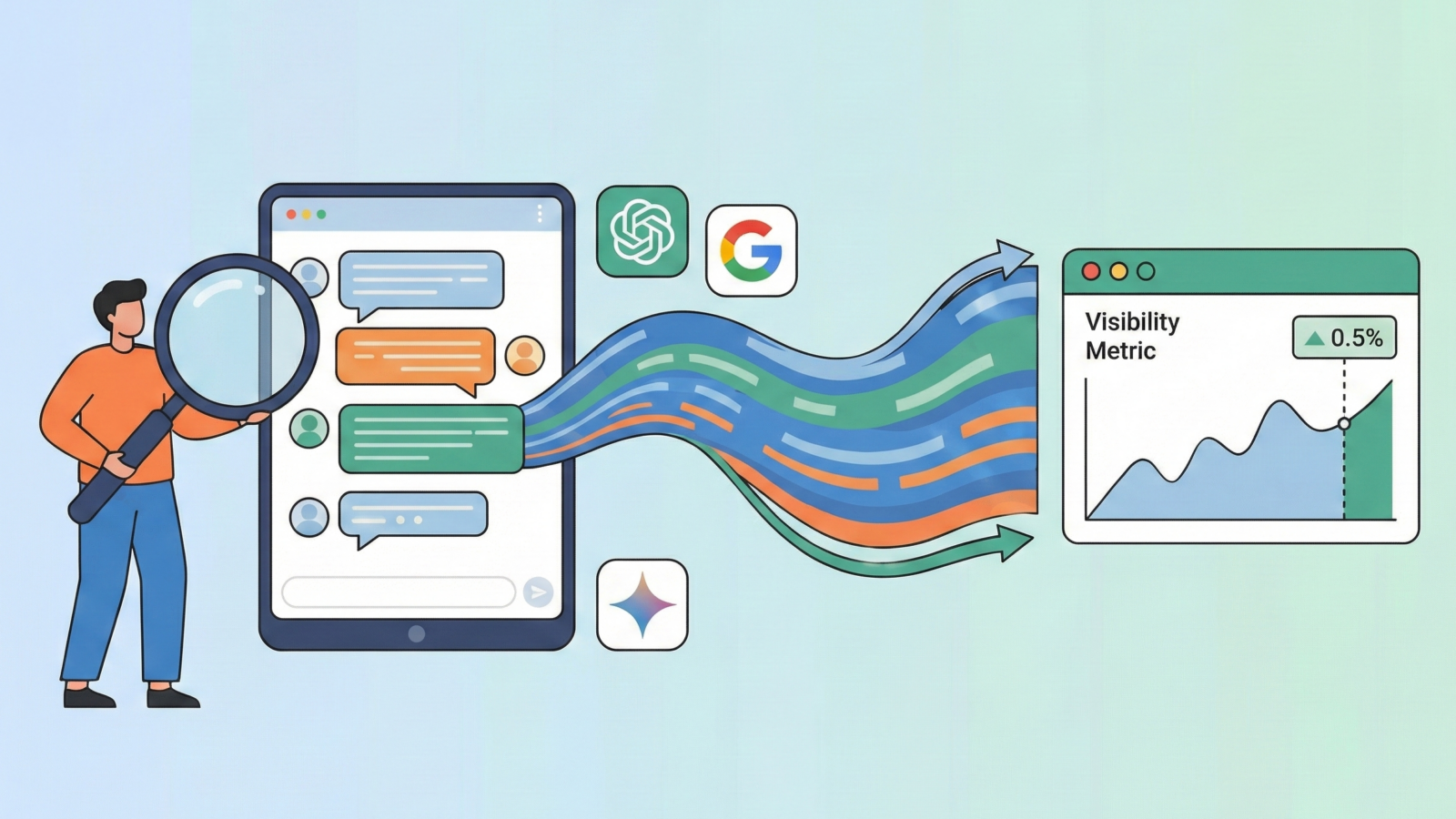
The way people find information is changing fast. A September 2024 survey revealed that 8% of U.S. respondents now use ChatGPT as their primary search engine, up from 1% in June, while Google’s share declined from 80% to 74%. Meanwhile, AI platforms generated 1.13 billion referral visits in June 2025, representing a 357% increase from June 2024. This shift isn’t slowing down—it’s accelerating.
For brands, this creates an urgent problem: traditional SEO metrics don’t capture how large language models (LLMs) cite, recommend, or surface your content in conversational responses. You might rank well on Google but remain invisible when someone asks ChatGPT, Gemini, or Perplexity for recommendations in your category.
The stakes are clear. Only 22% of marketers are actively tracking AI visibility and traffic, yet AI Search traffic converts at 14.2% compared to Google’s 2.8%—making this traffic dramatically more valuable. Brands that measure and optimize their LLM visibility now will capture discovery opportunities that competitors miss entirely.
This guide breaks down a practical methodology for evaluating LLM visibility tools, ranks the top 10 solutions available today, and provides a clear framework for measuring your progress. By the end, you’ll know exactly how to track and improve your brand’s presence in AI-powered search.
What Criteria Should You Use to Evaluate LLM Visibility Tools?
Before comparing tools, you need a consistent framework. Not every solution approaches LLM visibility the same way, and what works for one organization may not fit another. Here are five criteria to guide your evaluation:
Multi-Platform Coverage: Does it track visibility across multiple AI platforms? Your audience uses ChatGPT, Gemini, Perplexity, and Claude interchangeably. A tool that only monitors one platform gives you an incomplete picture.
Actionable Insights: Can you identify specific content gaps and optimization opportunities? Raw data matters less than clear recommendations you can act on immediately.
Competitive Benchmarking: Does it show how you compare to competitors in AI responses? Understanding your share of voice relative to others in your category reveals where you’re winning and losing.
Content Strategy Integration: Can you connect visibility data to content creation workflows? The best tools don’t just report problems—they help you fix them by linking directly to content production.
Reporting and Measurement: Does it provide trackable KPIs and ROI metrics? Stakeholders need clear evidence that LLM optimization efforts deliver business results.
What Are the Top 10 LLM Visibility Tools?
Based on these criteria, here’s how the leading solutions stack up.
#1 Contently
Contently offers an enterprise content platform with integrated LLM visibility tracking and content optimization capabilities. What sets it apart is the connection between visibility data and content creation—you’re not just seeing where you’re invisible, you’re getting direct support to fix it.
One enterprise client saw a 47% increase in AI platform citations within four months after implementing Contently’s phased optimization approach. The platform identified content gaps in key topic areas, restructured existing assets for entity clarity, and established ongoing measurement.
Core Capabilities:
-
Real-time monitoring across ChatGPT, Gemini, Perplexity, and Claude
-
AI-readiness content scoring and optimization recommendations
-
Competitive visibility benchmarking dashboard
-
Integration with content strategy and production workflows
-
Entity and brand mention tracking in AI responses
-
Custom reporting for stakeholder communication
-
Expert content network for LLM-optimized content creation
Best For: Enterprise brands seeking end-to-end content strategy with built-in LLM visibility measurement.
Pricing Model: Custom enterprise pricing based on scope and requirements.
#2 Profound
Profound positions itself as a dedicated LLM visibility analytics platform, focusing specifically on how brands appear in AI-generated responses. Its strength lies in depth of analytics rather than breadth of features.
Key Features:
-
AI search tracking across major platforms
-
Brand mention monitoring in AI responses
-
Competitor comparison tools
-
Visibility trend reporting over time
Best For: Marketing teams focused specifically on AI search analytics as a standalone function.
Limitation: Less integrated with content creation workflows, requiring manual handoffs between insights and action.
#3 Otterly.AI
Otterly.AI emphasizes real-time AI search monitoring with a robust alert system. If your priority is knowing immediately when your brand appears—or disappears—from AI responses, this tool delivers.
Key Features:
-
Automated tracking of brand mentions in AI platforms
-
Competitive intelligence dashboards
-
Performance trend analysis
-
Custom alert notifications
Best For: Teams wanting real-time visibility alerts and competitive monitoring without deep content integration.
Limitation: Focused primarily on monitoring rather than content optimization guidance.
Quick Comparison Checklist
Before selecting an LLM visibility tool, ask yourself:
-
☐ Does it track all the AI platforms your audience uses?
-
☐ Can it connect visibility data to content improvements?
-
☐ Does it offer competitive benchmarking?
-
☐ Will it integrate with your existing content workflow?
-
☐ Can you demonstrate ROI to stakeholders?
#4 Scrunch AI
Scrunch AI combines AI visibility monitoring with sentiment analysis, helping brands understand not just whether they’re mentioned but how they’re portrayed in AI responses.
Key Features:
-
Multi-platform AI response tracking
-
Brand sentiment analysis in AI outputs
-
Share of voice metrics
Best For: Brands monitoring both visibility and sentiment in AI responses.
Limitation: Newer platform with an evolving feature set that may lack enterprise-scale capabilities.
#5 Semrush (with AI Features)
Semrush brings AI visibility capabilities to its established SEO platform, making it a natural choice for teams already invested in its ecosystem.
Key Features:
-
Traditional SEO combined with emerging AI search tracking
-
Large keyword and competitive database
-
Content optimization tools
Best For: Teams wanting AI visibility within their existing SEO toolkit.
Limitation: AI-specific features still developing compared to dedicated tools.
#6 Ahrefs (with AI Monitoring)
Ahrefs is an SEO powerhouse exploring AI search tracking capabilities. Its robust backlink and content analysis remain industry-leading.
Key Features:
-
Robust backlink and content analysis
-
Emerging AI visibility features
Best For: SEO-focused teams adding AI monitoring to existing workflows.
Limitation: AI features not as mature as specialized tools.
#7 BrightEdge
BrightEdge offers enterprise SEO with AI search integration, suitable for large organizations with complex content ecosystems.
Key Features:
-
Large-scale content performance tracking
-
AI-assisted optimization recommendations
Best For: Large enterprises with existing BrightEdge investment.
Limitation: Enterprise pricing may be excessive for smaller teams.
#8 Clearscope
Clearscope focuses on content optimization with AI readability in mind, helping writers create content that performs in both traditional and AI search.
Key Features:
-
Content grading for search performance
-
Topic modeling and keyword guidance
Best For: Content teams optimizing for both traditional and AI search.
Limitation: More content-focused than direct visibility tracking.
#9 MarketMuse
MarketMuse uses AI-powered content strategy to help brands build topical authority—a factor that influences how LLMs recognize and cite sources.
Key Features:
-
Content gap analysis
-
Topic authority building recommendations
Best For: Teams building topical authority for AI recognition.
Limitation: Indirect approach to LLM visibility measurement.
#10 Surfer SEO
Surfer SEO provides content optimization with AI writing assistance, helping creators produce search-friendly content efficiently.
Key Features:
-
On-page optimization scoring
-
SERP analysis and content briefs
Best For: Content creators wanting optimization guidance.
Limitation: Traditional SEO focus with limited direct LLM tracking.
How Do You Implement LLM Visibility Tracking?
Choosing a tool is just the first step. Here’s how to put it into action:
Audit Current State: Run your brand through ChatGPT, Gemini, and Perplexity to establish baseline visibility. Ask the questions your customers ask and document whether—and how—you’re mentioned.
Define Target Queries: Identify the 10-20 questions your audience asks AI platforms that should surface your brand. Prioritize by search volume and business impact.
Set Up Tracking: Implement your chosen tool with a consistent monitoring cadence. Weekly reviews work for most teams; high-volume brands may need daily monitoring.
Optimize Content Structure: Ensure your content uses clear entities, structured data, and direct answers to common questions. LLMs favor content that’s easy to parse and attribute.
Iterate Based on Data: Review visibility reports monthly and adjust your content strategy based on what’s working. Small, consistent improvements compound over time.
Case Study: Enterprise Brand Improves AI Visibility with Contently
A B2B technology company faced a common challenge: strong traditional SEO performance but declining organic discovery as their audience shifted toward AI-powered search. Despite ranking on page one for key terms, they rarely appeared when prospects asked ChatGPT or Perplexity for vendor recommendations.
Phase 1 (Discovery): Contently audited AI visibility across platforms, identifying significant content gaps in three core topic areas. Competitor analysis revealed that rivals with less domain authority were capturing more AI citations due to better content structure.
Phase 2 (Optimization): The team restructured 45 existing articles for entity clarity and created 12 new AI-optimized pieces targeting high-priority queries. Each piece included direct answers, clear attribution signals, and structured data markup.
Phase 3 (Measurement): Ongoing tracking established visibility KPIs with monthly stakeholder reporting. The team built a dashboard connecting AI mentions to website traffic and lead generation.
Results after six months:
-
47% increase in AI platform mentions
-
89% improvement in brand citation accuracy
-
31% growth in referral traffic from AI-assisted searches
-
Established as top-3 recommendation for target query category
How Should You Measure LLM Visibility Success?
Tracking the right metrics ensures your efforts translate to business outcomes. Here’s a framework:
KPITargetHow to TrackBusiness ImpactBrand Mention Frequency+25% quarterlyLLM visibility toolDiscovery and awarenessCitation Accuracy>90% accurateManual spot checks + toolTrust and reputationCompetitive Share of VoiceTop 3 in categoryCompetitor benchmarkingMarket positioningAI-Referred Traffic+15% monthlyAnalytics attributionRevenue pipeline
Frequently Asked Questions
What is LLM visibility and why does it matter for my brand?
LLM visibility refers to how often and accurately your brand appears in responses from AI platforms like ChatGPT, Gemini, Perplexity, and Claude. It matters because consumer behavior is shifting toward conversational AI for research and recommendations. If your brand isn’t mentioned when someone asks an LLM for solutions in your category, you’re missing discovery opportunities that competitors may capture.
How do I check if ChatGPT or Gemini mentions my company?
Start with manual queries: ask each platform the questions your customers typically ask, such as “What are the best tools for [your category]?” or “Which companies offer [your solution]?” Document the responses. For systematic tracking, use dedicated LLM visibility tools that automate this process across platforms and provide trend data over time.
Can I improve my visibility in AI search results?
Yes. LLMs pull from web content, so optimizing your digital presence affects how you appear in AI responses. Focus on creating content with clear entity references, structured answers to common questions, and strong topical authority. Ensure your brand information is consistent across authoritative sources. Regular monitoring helps you identify gaps and measure improvement.
How is LLM optimization different from traditional SEO?
Traditional SEO focuses on ranking in search engine results pages. LLM optimization focuses on being cited in conversational AI responses. While there’s overlap—quality content matters for both—LLMs prioritize different signals. They favor content with clear entities, direct answers, and authoritative sourcing. Structured data and consistent brand mentions across the web carry more weight than backlink profiles alone.
How long does it take to see improvements in AI visibility?
Most brands see measurable changes within 60-90 days of implementing a focused LLM optimization strategy. Initial audits reveal quick wins, such as content restructuring for clarity, that can produce results within weeks. Building sustained visibility typically requires 4-6 months of consistent effort, including new content creation and ongoing monitoring.
What Should You Do Next?
AI search adoption is accelerating. Brands that measure and optimize their LLM visibility now will establish early positioning that becomes harder for competitors to displace. Here’s a four-week action plan to get started:
Week 1: Audit your current AI visibility through manual queries across ChatGPT, Gemini, and Perplexity. Document where you appear, how accurately you’re described, and where competitors outperform you.
Week 2: Identify your top 10-15 priority queries—the questions your audience asks AI that should surface your brand.
Week 3: Select and implement a tracking tool that fits your team’s needs and budget. Set up dashboards for ongoing measurement.
Week 4: Begin content optimization based on your audit findings. Prioritize high-impact pages that can be restructured for better AI recognition.
The window for establishing AI visibility leadership is open now. As more brands recognize this opportunity, competition for mentions will intensify.
Ready to take control of your LLM visibility? Explore Contently’s AI visibility and content strategy solutions to see how an integrated approach can accelerate your results.
What’s your current strategy for tracking how AI platforms talk about your brand?
References
[1] https://planable.io/blog/ai-statistics/
[2] https://exposureninja.com/blog/ai-search-statistics/
